Deploying an AI model from a promising prototype to a robust, real-world application is a critical yet complex journey. The landscape of deployment options has expanded dramatically, leaving many teams facing a crucial question: where and how should our models live in production? The choice isn’t just technical; it directly impacts your application’s performance, cost, reliability, and ability to scale.
This guide cuts through the complexity by comparing the three mainstream deployment paradigms: Public Cloud Services, On-Premises/Private Cloud, and Edge Computing. We’ll explore the core logic, ideal use cases, and practical trade-offs of each to help you build a deployment strategy that aligns with your business goals.
The Core Deployment Trinity: Understanding Your Options
The modern AI deployment ecosystem is broadly divided into three domains, each governed by a different philosophy about where computation and data should reside.
1. Public Cloud AI Services: The Power of Elasticity
Cloud AI platforms, such as AWS SageMaker, Azure Machine Learning, and Google Cloud Vertex AI, offer a managed, service-centric approach. Their primary advantage is elastic scalability, allowing you to deploy a model on a single GPU instance and scale out to a multi-node cluster within minutes to handle increased load. This model eliminates massive upfront capital expenditure (CapEx) on hardware, converting it into a predictable operational expense (OpEx).
Cloud platforms are ideal for scenarios requiring rapid iteration, variable workloads, or global reach. They provide integrated MLOps toolchains that can significantly reduce operational overhead. However, organizations must be mindful of potential pitfalls like egress costs for large data transfers, “cold start” latency for infrequently used services, and the long-term cost implications of sustained, high-volume inference.
2. On-Premises & Private Cloud: The Command of Control
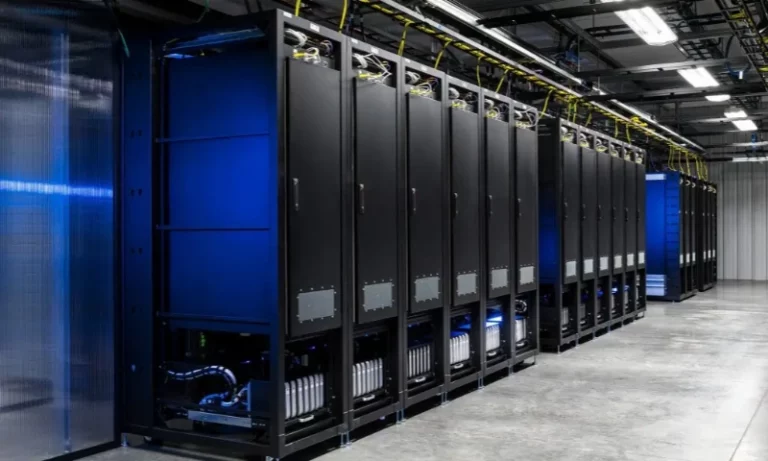
For many enterprises, especially in regulated industries like finance, healthcare, or government, maintaining direct control over data and infrastructure is non-negotiable. On-premises deployment involves hosting models on company-owned hardware, typically within a private data center or cloud (like an NVIDIA DGX pod). This approach offers the highest degree of data sovereignty, security, and network control.
The primary challenge shifts from operational agility to infrastructure management. Teams must procure, maintain, and optimize expensive GPU resources (such as clusters of NVIDIA H100 or A100 GPUs) and handle the full software stack. The initial investment is high, and maximizing the utilization of this fixed, finite resource pool becomes a critical engineering task to ensure a positive return on investment. This is precisely where intelligent orchestration platforms add immense value.
For enterprises navigating the complexity of private GPU clusters, a platform like WhaleFlux provides a critical advantage. WhaleFlux is an intelligent GPU resource management and AI service platform designed to tackle the core challenges of on-premises and private cloud AI. It goes beyond simple provisioning to optimize the utilization efficiency of multi-GPU clusters, directly helping businesses lower cloud computing costs while enhancing the deployment speed and stability of large models. By integrating GPU management, AI model serving, Agent frameworks, and full-stack observability into one platform, WhaleFlux allows teams to focus on innovation rather than infrastructure mechanics. It provides access to a full spectrum of NVIDIA GPUs, from the powerful H100 and H200 for massive training to the versatile A100 and RTX 4090 for inference and development, available through purchase or monthly rental to ensure cost predictability.
3. Edge AI: Intelligence at the Source
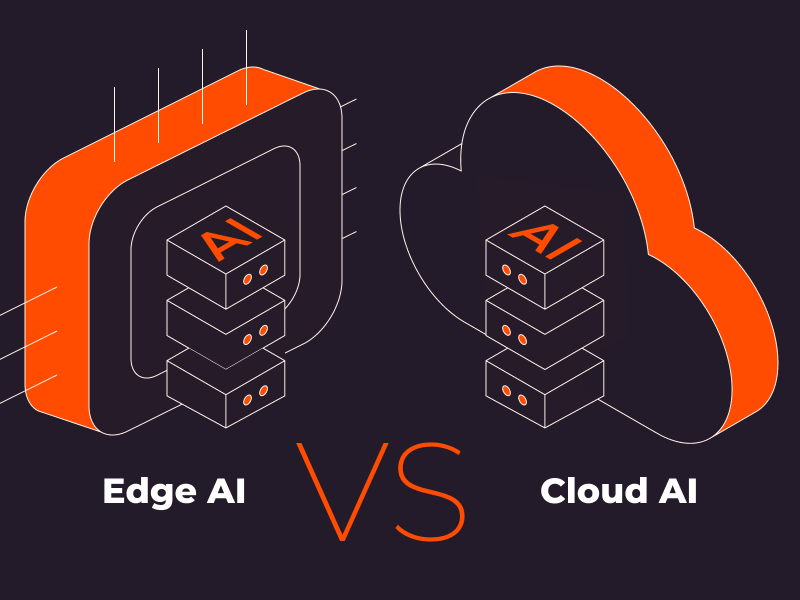
Edge AI represents a paradigm shift by running models directly on devices at the “edge” of the network—such as smartphones, IoT sensors, industrial PCs, or dedicated appliances like the NVIDIA Jetson. This architecture processes data locally, where it is generated, rather than sending it to a central cloud.
The benefits are transformative for specific applications: ultra-low latency for real-time decision-making (e.g., autonomous vehicle navigation), enhanced data privacy as sensitive information never leaves the device, operational resilience in connectivity-challenged environments, and bandwidth cost reduction. The trade-off is working within the strict computational, power, and thermal constraints of the edge device, often requiring specialized model optimization techniques like quantization and pruning.
Choosing Your Path: A Strategic Decision Framework
Selecting the right deployment target is not about finding the “best” option in a vacuum, but the most fit-for-purpose solution for your specific scenario. Consider these key dimensions:
- Latency & Responsiveness: Does your application require real-time feedback (e.g., fraud detection, interactive voice)? Edge or cloud-edge hybrid models are strong candidates. Batch processing or asynchronous tasks are well-suited for cloud or on-premises.
- Data Gravity & Compliance: Is your data highly sensitive, bound by strict regulations (GDPR, HIPAA), or simply too massive to move economically? This strongly favors on-premises or edge solutions.
- Cost Structure & Scale: Do you have predictable, steady-state workloads or spiky, unpredictable traffic? The former can justify on-premises investment for better long-term value, while the latter benefits from cloud elasticity.
- Operational Expertise: Do you have a team to manage servers, GPUs, and orchestration software? If not, the managed experience of cloud services or an integrated platform like WhaleFlux is crucial.
The Future: Hybrid Architectures and Optimized Inference
The most sophisticated production systems rarely rely on a single paradigm. The future lies in hybrid architectures that intelligently distribute workloads. A common pattern uses the public cloud for large-scale model training and retraining, a private cluster for hosting core, latency-sensitive inference services, and edge devices for ultra-responsive, localized tasks.
Furthermore, the industry’s focus is intensifying on inference optimization—the art of serving models faster, cheaper, and more efficiently. Advanced techniques like Prefill-Decode (PD) separation—which splits the compute-intensive and memory-intensive phases of LLM inference across optimized hardware—are delivering dramatic throughput improvements. Innovations in continuous batching, attention mechanism optimization (like MLA), and efficient scheduling are pushing the boundaries of what’s possible, making powerful AI applications more viable and sustainable.
Conclusion
There is no universal answer to AI model deployment. Cloud services offer speed and scalability, on-premises provides control and security, and edge computing enables real-time, private intelligence. The winning strategy involves a clear-eyed assessment of your technical requirements, business constraints, and strategic goals.
By understanding the core principles and trade-offs of these three mainstream solutions, you can design a deployment architecture that not only serves your models but also empowers your business to innovate reliably and efficiently. Start by mapping your key application requirements against the strengths of each paradigm, and don’t be afraid to embrace a hybrid future that leverages the best of all worlds.
FAQs: AI Model Deployment
1. What are the most critical factors to consider when deciding between cloud and on-premises deployment for an LLM?
Focus on four pillars: Data & Compliance (sensitivity and regulatory constraints), Performance Needs (latency SLA and throughput), Total Cost of Ownership (comparing cloud OpEx with on-premises CapEx and operational overhead), and Operational Model (in-house DevOps expertise). For example, a high-traffic, public-facing chatbot might suit the cloud, while a proprietary financial model trained on confidential data would mandate a private, on-premises cluster.
2. Our edge AI application needs to work offline. What are the key technical challenges?
Offline edge AI must overcome: Limited Resources (fitting the model into constrained device memory and compute power, often requiring heavy quantization), Energy Efficiency (maximizing operations per watt for battery-powered devices), and Independent Operation (handling all pre/post-processing and decision logic locally without cloud fallback). Success depends on meticulous model compression and choosing hardware with dedicated AI accelerators.
3. What is “inference optimization,” and why has it become so important for business viability?
Inference optimization is the suite of techniques (like model quantization, speculative decoding, and advanced serving architectures) aimed at making running trained models faster, cheaper, and more efficient. It’s critical because for most businesses, the ongoing cost and performance of serving a model (inference) far outweigh the one-time cost of training it. Effective optimization can reduce server costs by multiples and improve user experience through lower latency, directly impacting ROI and application feasibility.
4. How does a platform like WhaleFlux specifically help with the challenges of on-premises AI deployment?
WhaleFlux addresses the core pain points of private AI infrastructure: Cost Control by maximizing the utilization of expensive NVIDIA GPU clusters (like H100/A100), turning idle time into productive work; Operational Complexity by providing an integrated platform for GPU management, model serving, and observability, reducing the need for disparate tools; and Performance Stabilitythrough intelligent scheduling and monitoring that ensures reliable model performance. Its monthly rental option also provides a predictable cost alternative to large upfront hardware purchases.
5. We have variable traffic. Is a hybrid cloud/on-premises deployment possible?
Absolutely, and it’s often the most robust strategy. A common hybrid pattern is to use your on-premises or private cloud cluster (managed by a platform like WhaleFlux for efficiency) to handle baseline, predictable traffic, ensuring data sovereignty and low latency. Then, configure an auto-scaling cloud deployment to act as a “overflow” capacity during unexpected traffic spikes. This approach balances control, cost, and elasticity, though it requires careful design for load balancing and data synchronization between environments.