Imagine you need to cross town. You could call a massive, luxury coach bus—it’s incredibly capable, comfortable for a large group, and can handle virtually any route. But for a quick trip to the grocery store, it would be overkill, difficult to park, and expensive to fuel. You’d likely choose a compact car instead: nimble, efficient, and perfectly suited to the task.
This analogy captures the essential choice in today’s AI landscape: Small Language Models (SLMs) versus Large Language Models (LLMs). It’s not a simple question of which is “better,” but rather which is the right tool for your specific job. This guide will demystify both, helping you understand their core differences, strengths, and ideal applications so you can make strategic, cost-effective decisions for your projects.
Defining the Scale: What Makes a Model “Small” or “Large”?
The primary difference lies in scale, measured in parameters. Parameters are the internal variables a model learns during training, which define its ability to recognize patterns and generate language.
- Large Language Models (LLMs) are the behemoths. Think GPT-4, Claude, or Llama 2 70B. They typically have billions (B) to trillions (T) of parameters. Trained on vast, diverse internet-scale datasets, they are “jacks-of-all-trades,” exhibiting remarkable general knowledge, reasoning, and instruction-following abilities across a wide range of topics.
- Small Language Models (SLMs) are the specialists. Examples include models like Phi-3-mini (3.8B), DistilBERT, or a custom fine-tuned model. Ranging from millions (M) to a few billion parameters, they are often trained or refined on narrower, high-quality datasets for specific tasks. Their strength is not breadth, but targeted efficiency and precision.
The Great Trade-Off: A Head-to-Head Comparison
The choice between SLMs and LLMs involves balancing a core set of trade-offs. The table below outlines the key battlegrounds:
| Feature | Small Language Models (SLMs) | Large Language Models (LLMs) |
| Core Strength | Efficiency & Specialization | General Capability & Versatility |
| Parameter Scale | Millions to a few Billions (e.g., 1B-7B) | Tens of Billions to Trillions (e.g., 70B, 1T+) |
| Computational Demand | Low. Can run on consumer GPUs, laptops, or even phones (edge deployment). | Extremely High. Requires expensive, data-center-grade GPU clusters. |
| Speed & Latency | Very Fast. Ideal for real-time applications. | Slower. Higher latency due to computational complexity. |
| Cost (Training/Inference) | Low to Moderate. Affordable to train, fine-tune, and run at scale. | Exceptionally High. Multi-million dollar training; inference costs add up quickly. |
| Primary Use Case | Focused Tasks: Text classification, named entity recognition, domain-specific Q&A, efficient summarization. | Open-Ended Tasks: Creative writing, complex reasoning, coding, generalist chatbots, multi-step problem-solving. |
| Customization | Easier & Cheaper to fine-tune and fully own. Adapts deeply to specific data. | Difficult and expensive to train from scratch. Customization often limited to prompting or light fine-tuning via API. |
| Knowledge Cut-off | Can be easily updated via fine-tuning on the latest domain data. | Often static; knowledge is locked at training time, requiring complex (and sometimes unreliable) workarounds like RAG. |
When to choose which? A strategic guide:
Your decision should be driven by your project’s requirements, not the hype.
Choose an SLM if:
- You have a well-defined, repetitive task. For example, extracting product specifications from manuals, classifying customer support tickets, or powering a domain-specific chatbot that answers questions from your internal wiki.
- Latency and cost are critical. You need fast, cheap predictions at high volume (e.g., processing millions of product reviews for sentiment).
- You need to deploy on-premise or at the edge. Your application runs on mobile devices, factory floors, or in environments with limited connectivity and strict data privacy requirements (e.g., healthcare diagnostics).
- You want full control and ownership. You need to fine-tune the model extensively on proprietary data without sending it to a third-party API, ensuring complete data sovereignty.
Choose an LLM if:
- The task requires broad world knowledge or reasoning. You’re building a research assistant, a tutor that can explain diverse concepts, or a system that writes and debugs code across multiple languages.
- Creativity and open-ended generation are key. You need marketing copy, story ideas, or the ability to brainstorm freely on any topic.
- You are in the prototyping or exploration phase. You need a powerful, flexible tool to validate an idea quickly without investing in model training.
- Your task is highly variable or unpredictable. You need a single model that can handle a wide array of user queries without knowing them in advance, like a general-purpose customer service bot.
The Hybrid Future and the Platform Imperative
The most forward-thinking organizations aren’t choosing one over the other; they are building hybrid architectures that leverage the best of both worlds.
A classic pattern is using an LLM as a “brain” for complex planning and reasoning, while delegating specific, well-defined tasks to specialized SLMs or tools. For example, a customer query like “Compare the battery life and price of last year’s model to the new one” could involve:
- An LLM understands the intent and breaks it down into steps: find specs for Model A, find specs for Model B, extract battery life and price, compare.
- Specialized SLMs (or database tools) are invoked to perform the precise information retrieval and extraction from structured sources.
- The LLM then synthesizes the results into a coherent, natural-language answer for the user.
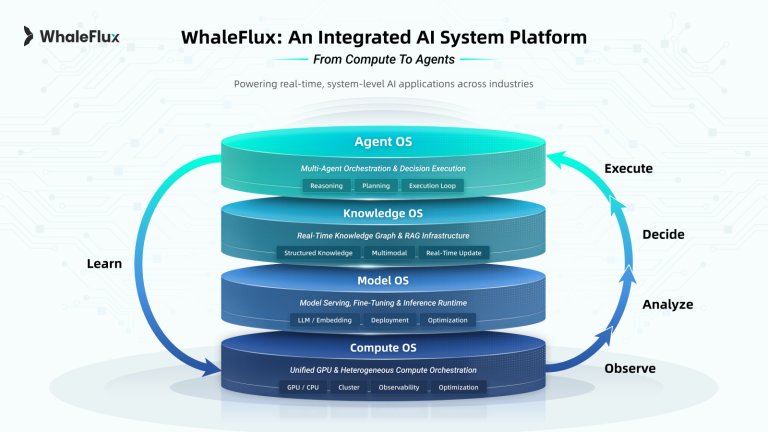
Managing this symphony of models—each with different infrastructure needs, deployment pipelines, and scaling requirements—is a monumental operational challenge. This complexity is where an integrated AI platform like WhaleFlux becomes a strategic necessity.
WhaleFlux acts as the unified control plane for a hybrid model strategy. It provides the tools to:
- Efficiently Develop SLMs: Streamline the process of fine-tuning smaller models on your proprietary data, handling the underlying infrastructure and experiment tracking.
- Orchestrate LLM Calls: Intelligently manage requests to various proprietary and open-source LLMs, optimizing for cost and performance.
- Build Robust Hybrid Flows: Visually design or code workflows that chain different models and tools together, like the customer service example above.
- Unified Deployment & Monitoring: Deploy both your custom SLMs and LLM gateways on the same scalable infrastructure, with comprehensive observability into performance, cost, and accuracy across all your AI components.
With a platform like WhaleFlux, the debate shifts from “SLM or LLM?” to “How do we best compose these capabilities to solve our problem?“—freeing your team to focus on innovation rather than infrastructure.
Conclusion: It’s About Fit, Not Size
The evolution of AI is not a straight path toward ever-larger models. Instead, we are seeing a strategic bifurcation: LLMs continue to push the boundaries of general machine intelligence, while SLMs carve out an essential space as efficient, deployable, and specialized solutions.
For businesses and builders, the winning strategy is pragmatic and task-oriented. Start by rigorously defining the problem you need to solve. If it’s narrow and requires efficiency, start exploring the rapidly advancing world of SLMs. If it’s broad and requires deep reasoning, leverage the power of LLMs. And for the most complex challenges, design hybrid systems that do both.
By understanding this landscape and leveraging platforms that manage its complexity, you can ensure that your AI initiatives are not just technologically impressive, but also practical, cost-effective, and perfectly tailored to drive real-world value.
FAQs: Small vs. Large Language Models
Q1: Can an SLM ever be as “smart” as an LLM on a specific task?
Yes, absolutely. This is the principle of specialization. An SLM that has been extensively fine-tuned on high-quality, domain-specific data (e.g., legal contracts or medical journals) will significantly outperform a general-purpose LLM on tasks within that domain. It won’t be able to write a poem about the task, but it will be more accurate, faster, and cheaper for the job it was trained for.
Q2: Are SLMs more private and secure than LLMs?
They can be, due to deployment options. An SLM can be run entirely on-premise or on-device, meaning sensitive data never leaves your control. When using an LLM via an API (like OpenAI’s), your prompts and data are processed on the vendor’s servers, which may pose privacy and compliance risks. However, some vendors now offer “on-premise” deployments of their larger models, blurring this line for a premium cost.
Q3: Is fine-tuning an LLM to make it an “SLM” for my task a good idea?
It’s a common but often costly approach called domain adaptation. While it can work, using a smaller model as your starting point is usually more efficient. Fine-tuning a huge LLM is expensive and computationally intensive. Often, a pre-trained SLM architecture fine-tuned on your data will achieve similar performance for a fraction of the cost and time.
Q4: What does the future hold? Will LLMs make SLMs obsolete?
No. The future is heterogeneous. We will see both scales continue to evolve. LLMs will get more capable, but SLMs will get more efficient and intelligent at a faster rate due to better training techniques (like distilled learning from LLMs). The trend is toward a rich ecosystem where the right tool is selected for the right job, with SLMs powering most everyday, specialized applications.
Q5: How do I get started experimenting with SLMs?
The barrier to entry is low. Start with platforms like Hugging Face, which hosts thousands of pre-trained open-source SLMs. You can often find a model for your domain (sentiment, translation, Q&A). Many can be fine-tuned and tested for free using tools like Google Colab. For production deployment and management, this is where a platform like WhaleFlux simplifies the transition from experiment to scalable application.