Introduction: The Cost of “Not Knowing”
Imagine a top sales executive spending 30 minutes digging through shared drives and old emails to answer a client’s technical question. Picture a seasoned engineer retiring, taking 20 years of troubleshooting wisdom with them. Consider the compliance risk of an employee accidentally using an outdated version of a policy document. These aren’t hypotheticals; they are daily, quantifiable drains on productivity, innovation, and risk management in the modern enterprise.
In today’s knowledge-driven economy, a company’s most valuable asset is not its physical inventory, but the collective intelligence locked within its documents, data, and employees’ minds. Yet, this asset is often the most underutilized. Traditional knowledge management—static intranets, folder hierarchies, and basic keyword search—has failed. It’s like having a library without a librarian or a catalog; the information exists, but finding the right answer at the right time is a matter of luck and labor.
This is where a paradigm shift is occurring. The convergence of Large Language Models (LLMs) with a powerful framework called Retrieval-Augmented Generation (RAG) is creating a new class of tool: the Smart, AI-Powered Knowledge Base. This isn’t just an IT project; it’s a strategic investment with a clear, compelling business case. This article will dissect that business case, demonstrating why implementing a RAG system is not a luxury for tech companies, but a necessity for every organization aiming to compete on efficiency, accuracy, and agility.
Part 1: Demystifying RAG—Beyond the Hype
First, let’s move beyond the acronym. RAG (Retrieval-Augmented Generation) is a simple yet revolutionary architecture that makes AI both powerful and trustworthy for business use.
- Retrieval: When a user asks a question, the system doesn’t just guess. It actively searches a secure, private database of your company’s information (PDFs, docs, wikis, CRM data) to find the most relevant excerpts.
- Augmentation: These retrieved facts and documents are packaged as “ground truth” context.
- Generation: This context is then given to an LLM (like GPT-4 or an open-source model) with the instruction: “Answer the question based solely on this information.”
The result? An AI that provides precise, sourced, and up-to-date answers specific to your business, dramatically reducing the “hallucinations” or fabrications that plague generic chatbots. It turns a general-purpose LLM into a dedicated, expert-level assistant for your company.
Part 2: The Tangible Business Value—Where RAG Impacts the Bottom Line
The ROI of a smart knowledge base built on RAG manifests across several key business pillars:
1. Supercharged Productivity & Operational Efficiency
Eliminate Search Friction:
Employees spend an average of 1.8 hours per day searching for information. A RAG system provides instant, conversational access to information, potentially reclaiming thousands of productive hours annually.
Accelerate Onboarding:
New hires can query the knowledge base like a veteran colleague, reducing time-to-competency from months to weeks. They can ask, “What’s our process for escalating a tier-2 support ticket?” and get an immediate, procedural answer.
Streamline Customer Support:
Support agents have answers from product manuals, past ticket resolutions, and engineering notes at their fingertips. This reduces average handle time (AHT) and increases first-contact resolution (FCR).
2. Risk Mitigation & Informed Decision-Making
Compliance & Consistency:
Ensure every employee, from HR to legal to operations, is using the latest, approved versions of policies, procedures, and regulatory guidelines. The AI cites its sources, creating an audit trail.
Reduce “Tribal Knowledge” Risk:
Capture and operationalize the expertise of retiring specialists or high-performing teams. The knowledge base becomes a living repository of institutional wisdom.
Data-Driven Insights:
By analyzing the questions asked, companies can identify knowledge gaps (what are people constantly searching for that doesn’t exist?), process bottlenecks, and training needs.
3. Enhancing Revenue & Customer Experience
Empower Customer-Facing Teams:
Equip sales and account management with instant access to product specifications, custom pricing models, and competitive intelligence, enabling them to respond to client queries with confidence and speed during critical conversations.
Create New Products:
The curated knowledge base can become the brain for customer-facing intelligent assistants, offering 24/7 personalized support or interactive product guides, directly enhancing the customer experience.
4. Foundation for Strategic AI Adoption
A RAG-powered knowledge base is not a dead-end project. It is the foundational data layer for a future-ready AI enterprise. It provides the clean, structured, and accessible knowledge necessary to power more advanced:
AI Agents:
Autonomous workflows that can execute tasks based on knowledge (e.g., an agent that not only answers a question about expense policy but also helps file an expense report).
Complex Analysis:
Cross-referencing market reports, internal strategy documents, and financial data to generate business intelligence summaries.
Part 3: The Implementation Blueprint—Overcoming Challenges with Integrated Platforms
The business case is clear, but the path to implementation can seem daunting. Key challenges include:
Technical Complexity:
Orchestrating data pipelines, vector databases, embedding models, and LLMs.
Security & Governance:
Ensuring sensitive data never leaks and access is properly controlled.
Observability & Trust:
Needing to understand why the AI gave a certain answer to debug errors and build user confidence.
This is where choosing the right platform becomes a strategic business decision. A piecemeal, DIY approach with multiple vendors can lead to integration hell, hidden costs, and security gaps.
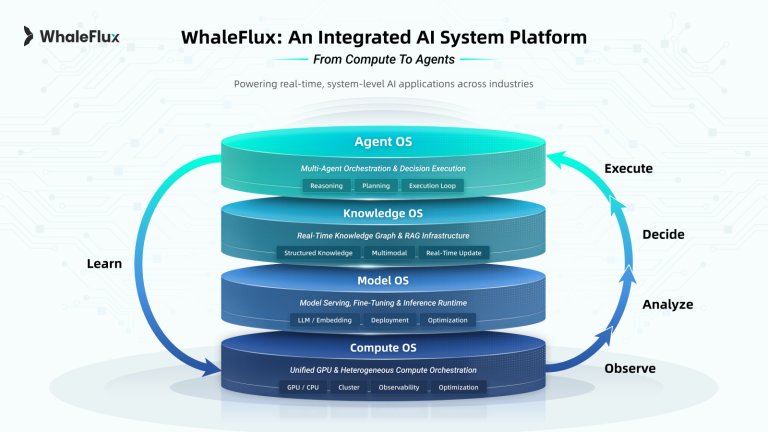
An integrated, all-in-one AI platform like WhaleFlux is designed to directly address these challenges and accelerate time-to-value.
WhaleFlux: The Business Platform for Operational AI
WhaleFlux isn’t just another tool; it’s a cohesive environment that encapsulates the entire lifecycle of an AI-powered knowledge base:
AI Computing & Model Management:
WhaleFlux provides the enterprise-grade infrastructure to run the entire RAG pipeline securely. Its model hub allows businesses to easily select, compare, and deploy the best LLM for their specific need and budget—switching between powerful open-source models and premium APIs without infrastructural headaches. This eliminates the cost and complexity of managing separate compute clusters.
AI Agent Orchestration:
Beyond building a Q&A system, WhaleFlux enables companies to evolve their knowledge base into proactive AI Agents. Imagine an agent in your CRM that, when asked about a client, instantly retrieves the latest contract terms, project milestones, and support interactions from your knowledge base and generates a comprehensive account summary. This moves from passive retrieval to active assistance.
AI Observability:
This is the cornerstone of trust and continuous improvement. WhaleFlux’s observability tools let administrators trace every interaction. You can see the exact documents retrieved for a query and how they influenced the final answer. This is critical for auditing, refining data sources, proving compliance, and ensuring the system’s outputs are reliable. For a business, this means mitigated risk and a clear understanding of your AI’s performance.
By consolidating these capabilities, WhaleFlux transforms RAG from a complex technical project into a manageable business initiative with a clear owner, controlled costs, and measurable outcomes.
Conclusion: The Strategic Imperative
The question is no longer if companies should leverage AI to manage their knowledge, but how quickly they can do it effectively. The business case for RAG is a multiplier: it simultaneously drives down costs (through efficiency), protects revenue (through risk mitigation), and unlocks new value (through enhanced services and innovation).
Investing in a smart knowledge base powered by RAG is an investment in your organization’s nervous system. It makes the entire company more intelligent, responsive, and resilient. Platforms like WhaleFlux provide the necessary turnkey solution to embark on this journey without getting lost in the technological weeds. The competitive advantage will belong to those who can harness their collective knowledge fastest. The time to build that foundation is now.
FAQs: The Business of RAG
1. We already have a search function on our intranet. How is this different?
Traditional search is like a card catalog; it gives you a list of documents where your keywords might appear. A RAG system is like a personal research assistant: it reads and understands all your documents, then synthesizes a direct, conversational answer to your specific question, citing the sources it used. It answers the intent, not just matches keywords.
2. What is the typical cost and ROI timeline for implementing a RAG system?
Costs vary widely based on scale and approach. No-code platforms (like WhaleFlux) offer subscription models with faster setup and lower initial cost, potentially showing ROI in months via productivity gains. A custom, large-scale build requires higher upfront investment but can deliver transformative enterprise-wide value. The key is to start with a high-impact, contained pilot (e.g., a specific department’s documentation) to prove value before scaling.
3. How do we ensure the AI doesn’t expose our confidential data?
Security is paramount. Enterprise platforms should offer private deployment options (on your cloud or on-premises) so data never leaves your control. Look for features like robust encryption (at rest and in transit), strict role-based access controls (RBAC), and comprehensive audit logs. The “Retrieval” step in RAG is inherently more secure than training a model on your data, as source access can be strictly gated.
4. What kind of data and documents work best to start with?
Start with structured, high-quality, and critical knowledge. Ideal candidates are: internal process manuals, product documentation, compliance policies, standardized operating procedures (SOPs), and curated FAQ sheets. Avoid starting with chaotic data like unfiltered email archives or unmoderated chat logs.
5. Can a RAG system integrate with our existing software (CRM, ERP, etc.)?
Yes, a well-architected RAG system is built for integration. Through APIs, it can connect to live data sources like Salesforce, ServiceNow, Confluence, or SharePoint. This allows the knowledge base to provide answers that incorporate dynamic data (e.g., “What is the current status of client X’s project?”), making it a true central brain for the organization.