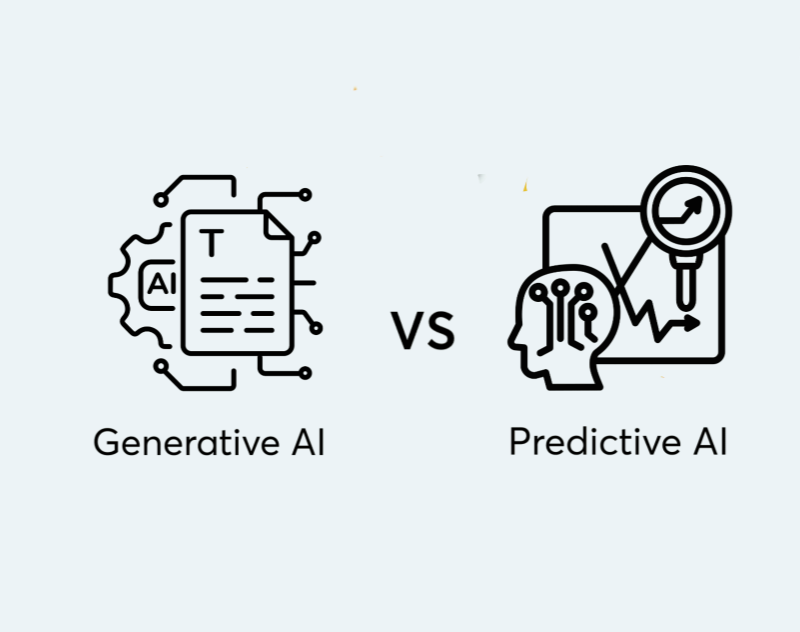
The “First Wave” of the AI revolution was defined by creativity. We marveled as Large Language Models (LLMs) penned poetry, generated photorealistic images, and drafted code from simple natural language prompts. This was the era of Generative AI—a transformative period that democratized content creation and personal productivity.
However, as we move deeper into 2026, the corporate boardroom is asking a different question. Creativity is valuable, but certainty is priceless. Businesses don’t just need AI that can write a marketing plan; they need AI that can tell them which marketing plan will actually work, which supply chain route will fail next Tuesday, and which customer is about to churn before they even know it themselves.
We are entering the Second Wave: Predictive and Prescriptive Intelligence. This is the shift from AI as a “Creator” to AI as a “Decision-Maker.”
1. The Limitation of “Just Generative”
Generative AI is inherently probabilistic regarding content. It predicts the next token in a sentence. While impressive, this “stochastic parroting” lacks a true understanding of cause and effect in the physical and financial world.
In a business context, a generative model might summarize a 100-page financial report perfectly. But it cannot, on its own, correlate that report with real-time geopolitical shifts, internal inventory levels, and fluctuating energy prices to provide a high-confidence forecast of Q4 margins.
Predictive Intelligence requires a different architecture. It demands the integration of structured historical data with unstructured real-time signals. It requires a system that doesn’t just “dream up” possibilities but calculates probabilities.
2. The Infrastructure Challenge of Predictive AI
Predictive models are notoriously data-hungry and compute-intensive in a way that differs from standard chat interfaces. To move from generative to predictive, an enterprise must handle:
High-Velocity Data Ingestion:
Processing millions of data points from IoT sensors, market feeds, and ERP systems.
Massive Parallel Processing:
Running complex simulations (like Monte Carlo methods) at scale.
Continuous Re-training:
Models must stay “fresh” to remain accurate as the world changes.
This is the technical “wall” where many AI projects fail. Traditional cloud environments often lead to skyrocketing costs and latency issues that make real-time prediction impossible.
This is where WhaleFlux
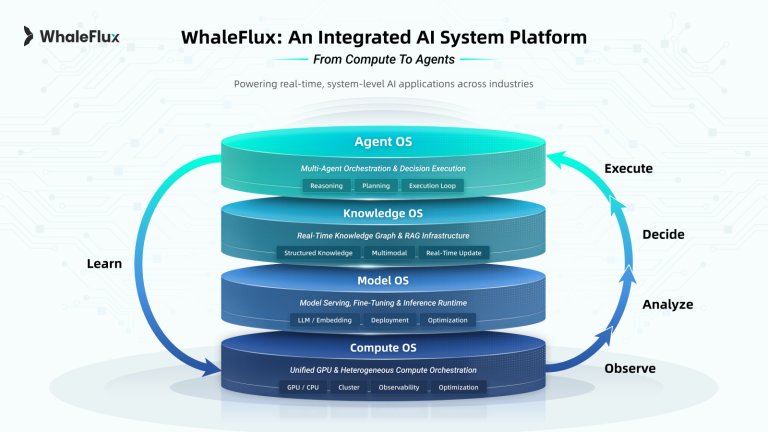
changes the game. To move from “creating content” to “forecasting outcomes,” you need an infrastructure that is built for high-performance execution. WhaleFlux provides the unified compute and model management layer that allows predictive engines to run at peak efficiency without the traditional overhead of fragmented AI stacks.
3. The Three Pillars of Decision-Making Intelligence
To achieve true predictive power in 2026, the industry is converging on three technical pillars:
I. Integrated Observability (The Feedback Loop)
You cannot predict the future if you don’t understand the present. Most AI systems today are “black boxes.” If a predictive model says, “Sales will drop by 10%,” but cannot explain why, no CEO will act on it.
- WhaleFlux Impact: WhaleFlux’s Full-Stack Observability doesn’t just monitor if a system is “up”; it tracks the decision-pathway of the models. By providing transparent insights into how data influences outcomes, WhaleFlux gives leaders the confidence to trust AI-driven forecasts.
II. Compute Orchestration (The Engine)
Predictive AI often involves “bursty” workloads. A retail company might need 1,000% more compute power on a Sunday night to run weekly inventory predictions than it does on a Monday morning.
- WhaleFlux Impact: Through Intelligent GPU Scheduling, WhaleFlux ensures that these massive predictive workloads get the priority they need exactly when they need it. By dynamically shifting resources, WhaleFlux prevents “compute bottlenecks,” ensuring that forecasts are delivered in minutes, not days.
III. Private Data Sovereignty (The Fuel)
The most valuable predictive insights come from your most sensitive data. You cannot send your proprietary trade secrets or customer behavioral data to a public cloud model for prediction without massive risk.
- WhaleFlux Impact: WhaleFlux enables Private AI Intelligence. It allows enterprises to host and refine predictive models within their own secure environment. This means your “Predictive Edge” stays entirely yours, protected by hardware-level isolation.
4. Real-World Applications: Forecasting the Future
The move to Predictive Intelligence is already reshaping core industries:
Manufacturing: The End of “Broken Machines”
Instead of a chatbot telling a technician how to fix a machine (Generative), predictive agents monitor vibration and heat signatures to tell the technician that the machine will break in 48 hours (Predictive). Using WhaleFlux to manage these high-frequency data models, manufacturers are achieving “Zero-Downtime” status.
Retail: Hyper-Accurate Inventory
In 2026, leading retailers no longer overstock. Predictive AI analyzes social media trends, local weather patterns, and historical sales to predict demand at a per-store level. With WhaleFlux optimizing the model micro-adjustments, these companies are reducing waste by up to 30%.
Logistics: Navigating Global Chaos
Global shipping is more volatile than ever. Predictive intelligence allows logistics firms to simulate thousands of “what-if” scenarios regarding port strikes, fuel spikes, or storms. WhaleFlux provides the high-performance environment needed to run these massive simulations in real-time, allowing for instant rerouting.
5. The Preservation of Value: Cost and Performance
The biggest fear of the “Predictive Era” is the cost. Running continuous simulations is expensive.
However, the “WhaleFlux Effect” changes the ROI equation. By optimizing the way models interact with GPUs and automating the lifecycle of the model (from data ingestion to refined output), WhaleFlux helps enterprises reduce their AI operational costs by up to 70%. This makes predictive intelligence accessible not just to the “Big Tech” giants, but to any enterprise ready to modernize its decision-making process.
6. Conclusion: From “What is?” to “What will be?”
The transition from Generative AI to Predictive AI is the transition from Information to Action. In 2026, the competitive advantage belongs to those who can see through the noise of the present to the probabilities of the future. But this vision requires more than just a smart algorithm; it requires a robust, observable, and efficient foundation.
WhaleFlux is that foundation. By unifying the “compute” and the “intelligence,” we enable businesses to stop guessing and start knowing. The frontier of decision-making intelligence is here—and it’s powered by high-performance, private, and observable AI.
Ready to forecast your future?
Discover WhaleFlux and see how our integrated AI platform can turn your data into your most powerful predictive asset.