In 2026, the corporate world has moved beyond the excitement of “chatting with data.” We are now in the era of the Autonomous Agent Workforce. Organizations are no longer looking for simple chatbots; they are building sophisticated, multi-agent platforms capable of reasoning, calling tools, and executing complex business logic with minimal human intervention.
However, moving from a prototype agent to an enterprise-grade AI agent platform is a monumental engineering challenge. Scaling autonomy requires more than just a powerful LLM; it requires a robust, layered architecture that can handle non-deterministic behavior, manage high-density compute, and ensure absolute reliability. This article deconstructs the blueprint of modern autonomy—the perception, decision, and execution layers—and introduces how WhaleFlux provides the critical Agent Orchestration foundation needed to turn these blueprints into reality.
The Blueprint: Three Pillars of Agentic Architecture
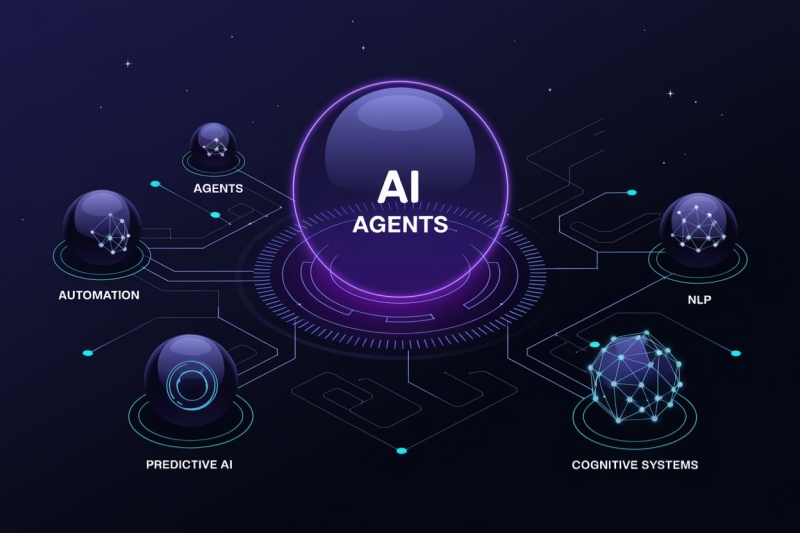
To build an agent that truly scales, we must separate its “intelligence” from its “operational logic.” A production-ready architecture is typically divided into three functional layers.
1. The Perception Layer: The Interface with Reality
The Perception Layer is the agent’s sensory system. In an enterprise environment, this isn’t just about reading text; it’s about Data Ingestion and Semantic Normalization.
Multimodal Input:
Processing structured SQL data, unstructured PDFs, real-time sensor streams, and API webhooks.
Contextual Filtering:
Not every piece of data is relevant. This layer must sanitize and filter noise to prevent “context overflow” in the reasoning engine.
Observation Loop:
Unlike a traditional program, an agent constantly “observes” the results of its previous actions. The perception layer feeds this feedback back into the system.
2. The Decision Layer: The Reasoning Engine
This is where the LLM resides, but the Decision Layer is more than just a model. It is the Reasoning and Planning hub.
Goal Decomposition:
Taking a high-level command (e.g., “Analyze the Q3 supply chain risks”) and breaking it into sub-tasks.
Memory Management:
Short-term memory (conversation buffer) and long-term memory (vector databases) allow the agent to learn from past interactions.
Constraint Enforcement:
Ensuring the agent operates within defined guardrails, such as budget limits or safety protocols.
3. The Execution Layer: Turning Logic into Action
If the decision layer is the “brain,” the Execution Layer is the “hands.” It is responsible for Tool Calling and System Interaction.
API Integration:
Interacting with ERP, CRM, or custom internal systems.
Sandbox Execution:
Running code or scripts in a secure environment to validate results before they go live.
Error Recovery:
Handling “retry” logic when a tool fails or an API returns a 404 error.
The Scaling Bottleneck: Why Orchestration is the Missing Link
While building a single agent is straightforward, managing a Multi-Agent Ecosystem is where most enterprises fail. When you have hundreds of agents performing concurrent tasks, you encounter the “Orchestration Gap”:
Resource Contention:
Which agent gets priority on the H100 cluster?
State Drift:
How do you keep state consistent across asynchronous workflows?
Data Friction:
The latency and overhead caused by moving data between fragmented service providers.
This is precisely where WhaleFlux transforms the architecture from a collection of scripts into a high-performance industrial platform.
WhaleFlux: The Hardened Control Plane for Autonomy
WhaleFlux is engineered for the “Execution” and “Orchestration” of autonomous intelligence. We provide the unified control plane that synchronizes your entire agentic stack.
WhaleFlux provides a production-hardened Agent Orchestration layer that abstracts the complexity of the underlying Compute Infra. By integrating model refinement and agent execution into a single, Hardened Control Plane, WhaleFlux eliminates the data friction that plagues multi-vendor setups. Our platform ensures that whether you are running a single reasoning agent or a massive autonomous workforce, every task is executed with 99.9% resilience and deterministic stability.
How WhaleFlux Powers the Autonomous Architecture:
Simplified Workflows:
WhaleFlux’s control plane allows architects to define complex “Agent Graphs” without worrying about the underlying GPU scheduling.
Silicon-Level Integration:
Because WhaleFlux manages the Compute Infra, your agents have direct, low-latency access to Fine-tuned Models, reducing the “time-to-action” for real-time agents.
Predictable ROI:
Through intelligent orchestration, WhaleFlux typically delivers a 40-70% reduction in TCO, allowing you to scale your agent platform without a linear increase in costs.
Conclusion
Building an AI Agent Platform for scale is a journey from “logic” to “infrastructure.” The perception, decision, and execution layers provide the framework, but Agent Orchestration provides the heartbeat. Without a hardened control plane like WhaleFlux, autonomy remains a fragile experiment.
As we move toward a future where agents handle mission-critical business operations, the winners will be those who architect for stability, security, and scale. By anchoring your autonomous workforce on WhaleFlux, you aren’t just building an agent—you are architecting the future of your enterprise.
Frequently Asked Questions (FAQ)
1. What is the difference between AI Orchestration and Agent Orchestration?
AI Orchestration generally refers to managing data and model pipelines. Agent Orchestration specifically focuses on the coordination of autonomous entities that reason, revise their plans, and use tools iteratively to reach a goal.
2. Why is a unified control plane important for scaling agents?
A unified control plane like the one provided by WhaleFlux ensures that policies, security protocols, and resource allocations are applied consistently across all agents. It prevents “orphaned agents” and ensures that multi-agent workflows don’t collapse due to resource contention.
3. Can I use WhaleFlux with my existing LangChain or LangGraph frameworks?
Yes. WhaleFlux is designed to be the Industrial Foundation for your agentic logic. You can build your agents using your favorite frameworks and use WhaleFlux to provide the Compute Infra, Model Refinement, and Production-Grade Execution needed to scale them.
4. How does the perception layer handle data privacy in a scaled platform?
In a hardened architecture like WhaleFlux, the perception layer can be integrated with Hardware-Level Sovereignty. This ensures that sensitive data is processed within secure enclaves, maintaining a zero-trust environment even as the agent interacts with external data sources.
5. How does orchestration help with agent “infinite loops”?
A robust orchestration layer monitors agent behavior in real-time. WhaleFlux’s control plane includes guardrails that detect “reasoning loops” or runaway API calls, automatically intervening or alerting administrators to prevent cost spikes and system instability.